
My Enneagram Journey
And why it’s one of the most powerful tools for the Inside Game of leadership.

I first heard about the Enneagram at a coaching retreat in 2017.
A fellow coach-in-training looked at me and said, “You must be an Enneagram 3.” I smiled, slightly embarrassed that I had no idea what an “Enneablahblahblah” even was. But my curiosity was piqued, and that moment quietly kicked off what has now been a nearly decade-long journey of studying the Enneagram, integrating its wisdom, and using it as a lens to better understand myself and how I show up as a mom, partner, friend, and leader.
She was right, by the way. I am a 3. And interestingly, so are a large percentage of the founders and executives I work with.
Over the last few years, I’ve had a number of people from earlier chapters of my career tell me that they experience me differently now. They say my energy feels different. What’s most notable is not just the observation, but my reaction to it.
There was a time when a comment like that might have landed as subtle criticism. I might have immediately wondered what they meant, whether I had somehow lost an edge or softened in a way that made me less effective. It would have hooked something in me.
But that wasn’t my response. Instead, I felt a quiet sense of recognition. Because they’re right. I am different than when most of them knew me.
Of course, part of that is life stage. Becoming a mom changes you in ways that are both profound and hard to fully articulate. But what I believe they’re really picking up on is something deeper. For a little over a decade now, I’ve been deeply committed to the work of understanding myself, healing old patterns, and getting to know who I actually am beneath all the doing. Said differently, I’ve been focused on my Inside Game—the work that sits beneath how we show up, decide, and lead.
Coaching and therapy have both played meaningful roles in my process. Alongside them, the Enneagram has served as a powerful gateway to growth, which is why I wanted to share my perspective on it here, along with an Enneagram for Beginners workbook I’ve created.
Before going further, it’s worth naming something I hear often, especially from founders and executives. For some, the Enneagram can feel a bit… woo woo. Or like just another personality assessment in an already crowded field.
I get that reaction.
There’s no shortage of tools that attempt to categorize people. Many of them stay at the surface level, describing behaviors without getting to what’s actually driving them. What I’ve found, and what has made the Enneagram stick for me over time, is that it operates at a different level. It’s less focused on what you do and more focused on why you do it.
That’s also why it can be more confronting, and ultimately more useful. In my experience, it is a much deeper and richer tool for self-awareness.
I have yet to meet a leader who doesn’t want to reach their full potential. But that doesn’t start with doing more or pushing harder. It starts with understanding ourselves more fully.
This is where the Enneagram comes in. It helps us recognize our underlying motivations, our fears, and our desires. The moments we get activated and why. The patterns we repeat, often without realizing it. And ultimately, the ways we may be unintentionally holding ourselves back in our leadership and in our lives.
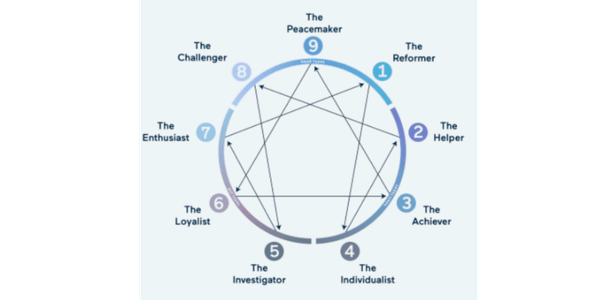
The Enneagram describes 9 Types, each with a way of organizing life around core ideas about self and life that feel true and necessary. Understanding our Primary Type reveals, often with uncomfortable clarity, the difference between who we truly are (our nature, Self, or essence) and who we think we need to be (the ego).
It helps us see the identity we’ve constructed in response to our experiences and our attempts to feel safe, understood, valued, or successful. It also helps us recognize the patterns that have been running us, so we can gradually loosen their grip and allow more grounded, present, and whole versions of ourselves to emerge.
While we each have a Primary Type, all nine exist within each of us. As you begin to learn the full system, you start to see the world through multiple lenses. You begin to understand that what appears to be stubbornness in one person might be a deep need for integrity. What looks like intensity in another might be a way of creating safety. What looks like detachment might be a strategy for managing overwhelm.
In understanding all nine Types, you begin to see both the gifts and the suffering embedded in each. The Enneagram becomes a powerful tool for appreciation and empathy, ultimately showing up as more effective communication, clearer feedback, stronger collaboration, and better leadership.
Before doing this work, I was what the Enneagram would describe as an “unhealthy 3”. I was highly driven, achievement-oriented, and almost always in motion. My default pace was fast, and my orientation was forward, focused on what was next and what more I could do.
On the surface, it looked like ambition, discipline, and success. And to be fair, those qualities served me in many ways. They helped me build, achieve, and create opportunities I am deeply grateful for.
But underneath it all was a dynamic I couldn’t see at the time.
My identity was deeply tied to my work. It was where I felt most confident and most validated. It mirrored how I grew up, where achievement through grades and sports was rewarded and reinforced. Without realizing it, I had internalized a belief that my worth was connected to what I could do and accomplish.
And so I kept going.
I spent a lot of time competing and comparing. I was constantly measuring myself against others and against some future version of myself I thought I needed to become. There was very little space to simply be who and where I was.
Feedback, in that context, was particularly charged. Even when it was well-intended, it often landed as a threat, not just to my performance, but to my identity. If I wasn’t doing something well, what did that say about me?
So I reacted. I got defensive. I worked harder. I tried to close the gap as quickly as possible. From the outside, it likely looked like high standards and drive. From the inside, it often felt like immense pressure and attachment.
The Enneagram helped me see not just these behaviors, but the underlying motivations and fears driving them. It gave language to patterns I had normalized and showed me how much of my life was organized around being seen a certain way, and how exhausting that actually was.
It also helped me understand my relationship with emotions, particularly shame (Type 3’s Predominant Emotion). I didn’t relate to it at first. I didn’t see myself as someone driven by shame, nor did I identify with being in the Heart Center. But it started to make sense when I learned that this disconnect is common for 3s. Busyness can be a very effective way to avoid feeling our emotions.
The Enneagram made the cost of my patterns clear. Not just to me, but to the people around me. I was often unavailable, so focused on the next fundraise or strategic partnership. My pace created subtle pressure for others. And at times, I unintentionally prioritized outcomes over connection, even when relationships mattered deeply to me.
That level of awareness can feel destabilizing… and it is also liberating.
Over time, I began to shift. I didn’t become a different person. The core wiring of a 3 is still very much there, but the way it’s expressed has changed. I am operating at a higher level of consciousness and, in Enneagram speak, I am now a “healthy 3”.
Today, I show up with less performing and more being. I focus less on how things look from the outside and give far more attention to how they feel from the inside. My drive toward potential is still present, but it comes from a more grounded place, one oriented around realization rather than proving.
I am more present, more patient, and more connected to the moment I’m actually in. I’m better able to find joy in the ordinary and less attached to the extraordinary. There is more self-compassion and less internal criticism. Perhaps most importantly, there is less attachment to achievement as a source of worth.
The patterns still arise, and the ego still shows up, but I can see them more clearly. In that awareness, I have more space to choose how I respond. Some days I do better than others.
Overall, the more time I spend with the Enneagram, the more time I spend with my true Self. And that, in itself, has been a profound gift.
Where to Start
If you’re curious about using the Enneagram to facilitate your growth, you are probably wondering where to begin.
This may be controversial, but I am not a big believer in starting with an Enneagram test. I have seen too many people mistype, often because we tend to answer based on who we think we are or want to be (damn ego!) rather than what is actually driving us beneath the surface.
In my experience, the most reliable way to understand your Type is through study, reflection, and honest self-observation over time. Reading about the Types, noticing what resonates, and paying attention to your patterns in real life will get you much closer than a single test result. Working with a coach who understands the system can also be incredibly helpful.
If you do want to begin with an assessment, I generally recommend the RHETI, developed by Don Riso and Russ Hudson, who have played a significant role in bringing the Enneagram into broader awareness and have written some of the most respected books on the subject.
Their work is excellent, though often dense and time-intensive. Part of why I created my Enneagram for Beginners workbook was to offer a more accessible entry point. Something that helps you understand the Types, reflect on your own patterns, and begin engaging with this work in a practical way.
I also suggest listening to The Upbuild Enneagram Library podcast. I have studied with Upbuild, and their Enneagram content is fantastic. They also offer an Enneagram Circle, which I’ve participated in and found incredibly valuable. There’s something powerful about exploring this work in community with others.
As you embark upon your own Enneagram journey, remember that, like any Inside Game work, there aren’t shortcuts, only a path you engage with over time. The work is gradual, layered, and ongoing, but it can also be profoundly rewarding… deepening your understanding of yourself, your relationships, and your leadership.

I designed this workbook as resource I wish I’d had when I started this work nearly a decade ago. It give you a break down of the system, Types, core emotional patterns and fixations that I find helpful for identification — and gives you the contemplation prompts and in-the-moment inquiries to begin seeing your own patterns more clearly.